
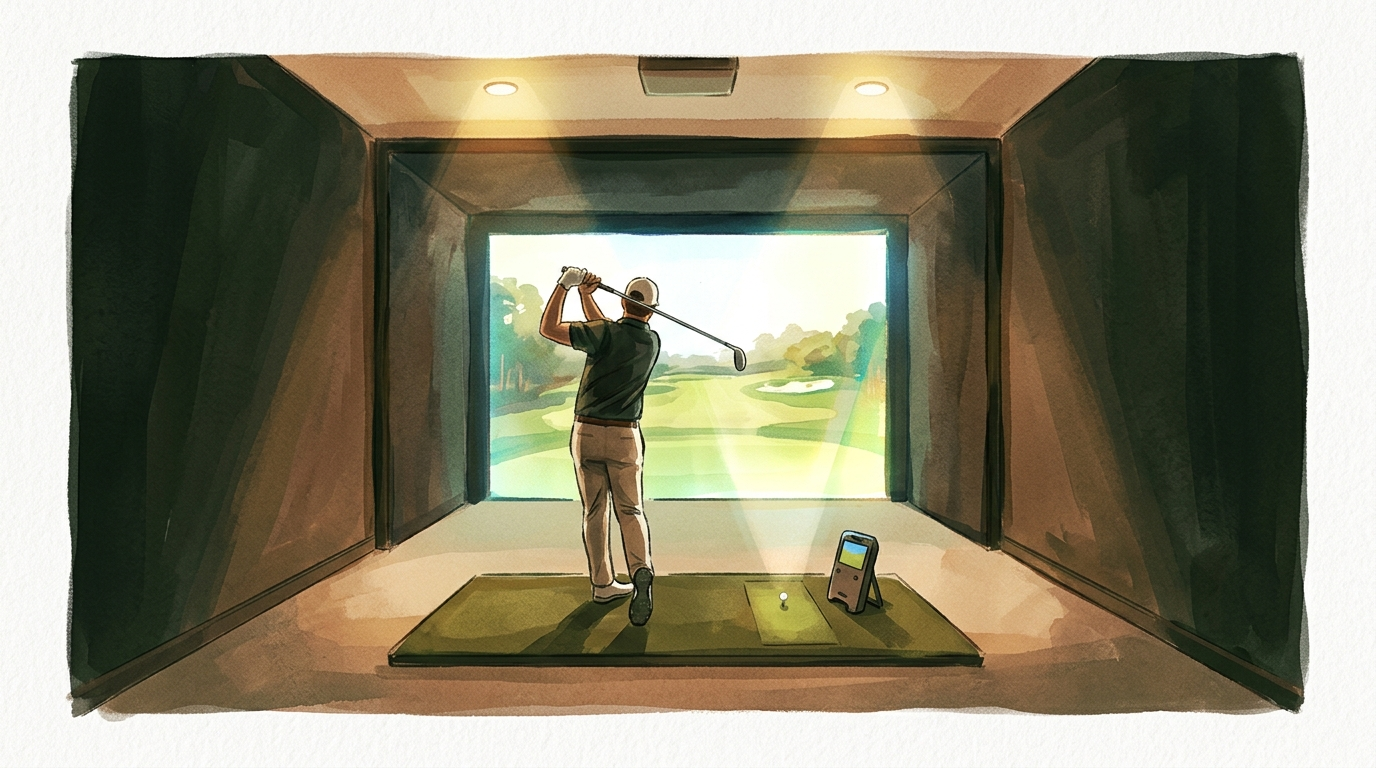
A golf simulator is a system that lets you hit a real golf ball into a screen and plays a virtual version of the shot on a projected course. You swing a real club, hit a real ball, and the technology tracks what happened, including club speed, launch angle, spin, and ball flight, then shows you where the ball would have gone on a real course.
Simulators are the core technology behind the indoor golf scene in the Philippines and globally. If you've seen venues with private bays and projected fairways, this is what they're running.
How the Technology Works
Every simulator has three main components:
Launch monitor. This is the sensor that tracks your shot. It sits either behind the ball (rear-mounted, like Trackman) or overhead/to the side (camera-based, like GCQuad or Uneekor). It measures club head speed, ball speed, spin rate, launch angle, and more.
Projection system. A high-resolution projector displays the virtual course on a large screen or wall. The image updates in real time to show your ball flight, landing position, and surroundings.
Software. The simulation software renders the course, calculates ball physics, and handles game modes. Most systems include a library of real-world courses you can play virtually.
What the Data Looks Like
After every shot, the launch monitor gives you a data readout. The exact metrics depend on the system, but most show:
- Ball speed. How fast the ball leaves the club face.
- Launch angle. How high the ball takes off.
- Spin rate. How much the ball spins (affects curve and stopping power on the green).
- Carry distance. How far the ball flies before landing.
- Total distance. Carry plus roll.
- Club head speed. How fast you're swinging.
You don't need to understand all of these to enjoy a sim session, but if you're practicing, the data tells you exactly what your swing is doing.
What to Expect at a Sim Venue
Most indoor golf venues in Metro Manila and other Philippine cities operate on an hourly bay rental model. Here's what a typical visit looks like:
Book a bay. Most venues take reservations. Walk-ins are sometimes available, but peak hours (evenings and weekends) fill up.
Bring your clubs or borrow theirs. Some venues provide house clubs at no extra charge. Others charge a rental fee. If you have your own, bring them.
Pay by the hour. Bay rental is charged per hour, regardless of how many people are in the bay. Prices vary by venue, day, and time slot. Most bays fit 2 to 6 people comfortably for a social session.
Food and drinks. Many sim venues have a food and beverage menu. Some are full restaurant setups. This is part of the appeal for social groups.
Game modes. Beyond playing a full virtual round, most simulators offer driving range mode, closest-to-the-pin challenges, and other mini-games. Good for groups where not everyone is a serious golfer.
You can browse indoor golf venues, hourly rates, and simulator details across the Philippines on our virtual golf directory.
Indoor vs. Outdoor: What's Different
Simulators are not a replacement for playing an actual course. They're a different experience with different strengths.
What sims do well. Consistent practice environment. Instant shot data. No weather delays. Faster rounds. Convenient locations (you don't have to drive an hour to a course). Great for social groups who want golf-adjacent entertainment.
What sims don't do. Putting feels different on a simulator mat versus a real green. Reading breaks, wind, elevation changes, and course management are approximate. Bunker play and chipping around the green are the weakest part of most sim systems.
For practicing your full swing, especially with irons and driver, simulators are excellent. For refining your short game and course feel, nothing replaces actual course time.
Do You Need to Be Good at Golf
No. Simulators are beginner-friendly. The system tracks your shot regardless of skill level, and most venues cater to social groups as much as serious golfers. If you've never swung a club, a sim venue is a low-pressure place to start.